How the Instagram algorithm ranks posts in 2026, according to Instagram
Instagram ranks Feed, Stories, Explore, and Reels separately, and its head named watch time, likes, and sends as the signals that matter most. Here is what Instagram itself has said, with dates, including the April 2026 rule on accounts that mostly repost.
12 min read



On this page
Instagram does not have one algorithm. Feed, Stories, Explore, Reels, and Search each rank posts their own way, and each one is built from predictions about what a given person will do next: stop on a post, like it, send it to a friend, or watch it to the end. That is how Instagram itself describes it, and it has published a fair amount about the details.
This guide sticks to what Instagram and its head, Adam Mosseri, have said in public, with the date of each statement, as it read on October 24, 2026. Ranking changes often, so treat any claim older than a year as something to check again. The latest change covered here came on April 30, 2026, when Instagram stopped recommending accounts that mostly repost other people's photos and carousels.
The short answer
- Instagram ranks each part of the app separately. Feed and Stories lean on accounts you follow, while Explore and Reels mostly show accounts you do not follow.
- Mosseri named three signals as the most important in January 2025: watch time, likes, and sends. Likes count slightly more with your followers, and sends count slightly more with people who do not follow you yet.
- He told creators to watch rates, not totals: average watch time, likes per reach, and sends per reach.
- Since April 30, 2026, accounts that mostly post other people's photos, carousels, or reels are not recommended to non-followers. Your followers still see them.
- Some posts are allowed on Instagram but never recommended, such as content that breaks the Recommendation Guidelines, and reels with another app's watermark.
- Account Status, in your Instagram settings, tells you whether your account can be recommended at all.
Each part of the app has its own ranking
In a post called "Instagram Ranking Explained" (May 31, 2023), Mosseri wrote that Instagram uses "a variety of algorithms, classifiers, and processes, each with its own purpose." Feed, Stories, Explore, Reels, and Search each have their own, because people use them for different things: Stories for close friends, Explore for discovery, Reels for entertainment.
The process is similar everywhere. Instagram first gathers the posts it could show you, then scores them on thousands of signals, then predicts how likely you are to take certain actions. Posts with the highest predicted value go first. Here is what the 2023 post says each surface predicts and weighs most.
| Part of the app | Whose posts it ranks | Actions Instagram predicts | Signals it weighs most, roughly in order |
|---|---|---|---|
| Feed | Accounts you follow, recommended accounts, ads | Spending a few seconds on a post, commenting, liking, sharing, tapping the profile photo | Your activity, information about the post, information about the person who posted, your history with that person |
| Stories | Accounts you follow, ads | Tapping into a story, replying, skipping to the next one | Viewing history, engagement history, closeness |
| Explore | Mostly accounts you do not follow | Likes, saves, shares | How popular the post is and how fast it gets reactions, your activity in Explore, your history with the poster, information about the poster |
| Reels | Mostly accounts you do not follow | Resharing, watching all the way through, liking, opening the audio page | Your activity, your history with the poster, information about the reel, information about the poster |
One detail matters for small accounts: in Explore, popularity signals such as how many people like, share, and save a post, and how quickly, "matter much more" than in Feed or Stories. For Reels, Instagram also surveys people about whether a reel was worth their time.
Followers and non-followers: the split that matters most
In January 2025, Mosseri started a video series on ranking. The first post (reported by Social Media Today on January 22, 2025) splits reach into two kinds:
- Connected reach: people who already follow you.
- Unconnected reach: people who do not follow you yet.
For both, he named the same three signals as the most important: watch time, likes, and sends. Then he added one nuance: "likes are slightly more important for connected content, and sends are slightly more important for unconnected content."
He also told creators what to look at in their insights: average watch time, likes per reach, and sends per reach. All three are rates. A post that 300 people saw and 30 people sent to a friend tells Instagram more than a post that 3,000 people saw and 30 people sent.
Mosseri did not publish weights. "Slightly more important" is as precise as he got, so be wary of any article that turns it into a multiplier such as "a send is worth five likes." For how to calculate the sends rate from your own numbers, see our guide to sends per reach on Instagram.
The four principles from the later videos
A later video in the same series, part two, goes beyond engagement. Its caption reads that Instagram also tries "to value originality, recency, breaking content", and that it now has "larger AI models to do better at ranking overall." The post page we read does not show a publish date, so we cannot date it more precisely than "after January 2025."
What each one means, in plain terms:
- Originality. The person who made something should get more distribution than accounts that repost it. This is the principle behind the April 2026 change below.
- Recency. Instagram wants new posts to reach people quickly. TrueFuture Media's summary of the video (September 9, 2026) reports that Instagram tracks the share of each day's impressions that go to posts less than 24 hours old.
- Breaking content. Instagram shows posts from smaller public accounts to some non-followers, and if they do better than expected, shows them to more people. A large following is not the only way to be discovered.
- Model size. This is about Instagram's own systems, not your content. There is nothing for you to change.
What makes Instagram stop recommending a post
Being allowed on Instagram and being recommended are two different bars. The 2023 post explains that Instagram keeps Recommendation Guidelines for the places where it suggests content from accounts you do not follow: Explore, Reels, Search, suggested posts in Feed, and suggested accounts. Posts that go against those guidelines stay up but are not recommended. The examples it gives include violence such as people fighting, and the use of regulated products such as tobacco, vaping products, or pharmaceutical drugs.
For reels, the same post lists more reasons Instagram may make a reel "less visible": low resolution, a watermark, no sound, borders, mostly text, or a reel that has already been posted on Instagram. In Feed, Instagram also tries not to show too many posts from the same account in a row.
If an account repeatedly posts content that goes against the Recommendation Guidelines or the Community Standards, none of its posts can be recommended for a period of time. Account Status, in your settings, shows whether your account and content are eligible.
The April 2026 change: accounts that mostly repost
On April 30, 2026, Instagram's creators blog announced that the originality rules it had applied to reels since 2024 now cover photos and carousels too. Accounts that "primarily post unoriginal content in photos or carousel posts, in addition to reels, will no longer be shown in places where we recommend content." TechCrunch reported the same day that this includes the Discover tab and recommendations in people's feeds.
What the announcement says, point by point:
- Followers are not affected. The change does not alter how Instagram shows content from accounts people already follow. It removes the account from recommendations to everyone else.
- It is judged over 30 days. An account becomes eligible again when most of its recently posted photos, carousels, and reels count as original over a rolling 30-day period.
- You can see it and appeal. Account Status shows whether your reach is limited, and you can remove the posts in question or appeal.
- Original means you made it, or you changed it meaningfully. Photos and videos you took, content you designed, and third-party material you materially edited all count. Adding text that gives real context, graphics with new information, or using the remix feature are the examples Instagram gives.
- A credit is not enough. Re-uploading someone else's work with only a border, a watermark, subtitles, or a credit in the caption does not count as original.
Instagram also said that 75% of recommendations in the US now come from original posts. If you want to feature a customer's photo or a creator's video, Instagram's own suggestions are collabs, remix, reposts, and sharing to your story, which credit the original account.
What this means for a small business account
Put together, the official statements point to a short list of habits. None of them is a trick, and none comes with a promised number.
- Post your own photos and video. A shop that shoots its own products and a cafe that films its own kitchen are already original. If you curate other people's content, make it a minority of what you post and use collabs or reposts for it.
- Make posts worth sending. Sends are the signal Mosseri ties most closely to reaching new people. A price list, a before and after, a how-to, or an answer to a question customers keep asking are things people forward to someone.
- Hold attention in the first seconds of a reel. Watching to the end is one of the main predictions for Reels. Say what the reel is about at the start, on screen as well as out loud, so it works for people watching without sound.
- Post reels without other apps' watermarks. If you also post to TikTok, export a clean copy for Instagram. Our guide to posting one vertical video to TikTok, Reels, and Shorts covers the file specs.
- Spread posts out. Instagram avoids showing many posts from one account back to back, so three posts in an hour compete with each other.
- Check Account Status once a month. It is the only place Instagram tells you directly that your account cannot be recommended.
Where to see these signals in Instagram Insights
The names in Instagram Insights do not always match the words Mosseri uses, and older guides use other labels again. According to Meta's help page "About Instagram insights", read on October 24, 2026:
- Views counts how many times your content was played or displayed, repeats included.
- Viewers counts unique accounts that saw your content at least once. This is the closest match to what Mosseri calls reach.
- Interactions counts actions such as likes, comments, saves, and shares.
- Accounts engaged can be split into followers and non-followers for posts, stories, and lives.
Tap View insights under any post or reel to see its numbers, and tap the (i) icon to read each metric's definition. For reels, Instagram's help page "View insights on your Instagram reels" lists average watch time, which is watch time divided by the number of initial views. Insights are available to public accounts, personal or professional.
To get Mosseri's rates for one post, divide likes by viewers, and shares by viewers. Compare those rates across the last 20 or 30 posts rather than judging one post on its own.
Read the same numbers in eksis
eksis does not change how Instagram ranks anything, but it keeps the numbers for every post in one table, so you can compare rates without opening each post's insights.
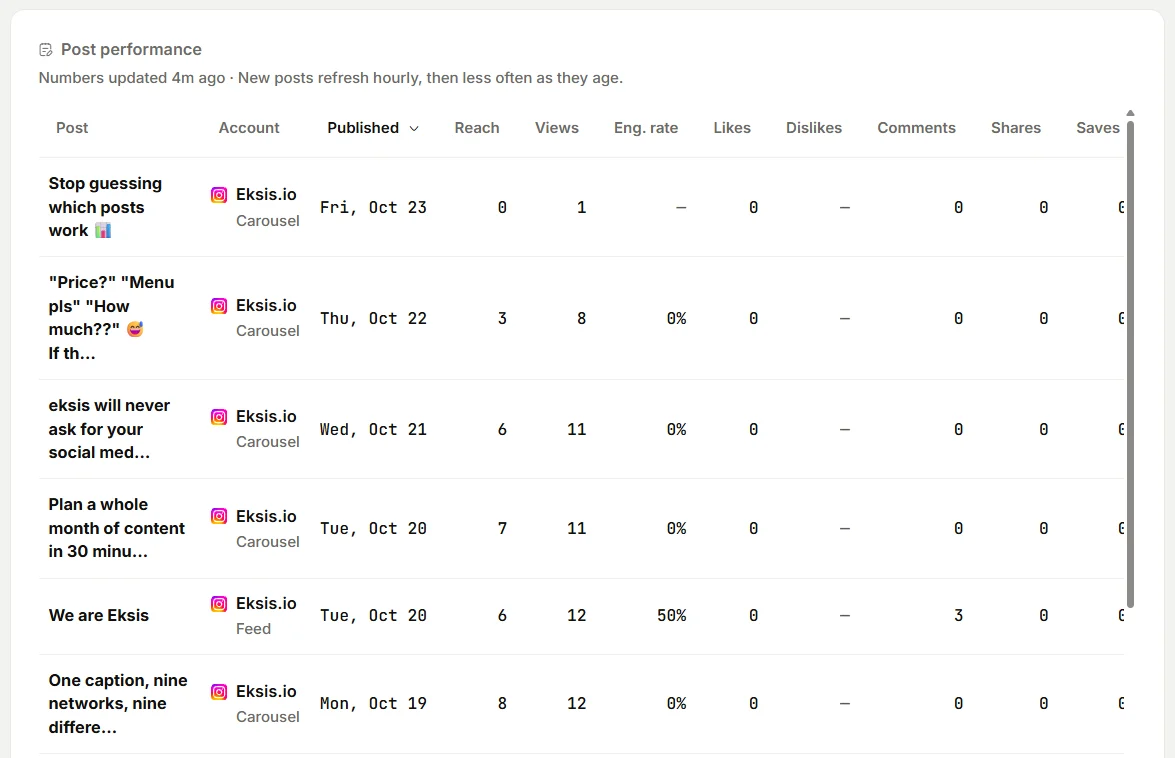
- Open Analytics in the sidebar and pick 7, 30, or 90 days. To look at Instagram alone, select Insights under your Instagram account in the sidebar.
- Post performance lists each post with its reach, engagement, profile visits, and engagement rate. In eksis, engagement is likes plus comments plus saves plus shares, and engagement rate is engagement divided by reach. Posts you published from the Instagram app are included too.
- For likes per reach and sends per reach, choose Export, then Posts. The file has separate columns for reach, likes, comments, saves, and shares for each post, up to the 200 most recent posts in the period.
- Best hours to post averages the engagement of your own posts by the hour they went out, in your workspace time zone. Faded bars come from a single post and are too few to judge.
Analytics starts on the Starter plan; the Free plan connects one account and schedules 15 posts a month, without Analytics. Numbers usually arrive within an hour of publishing, and eksis stops updating a post 30 days after it went out. Reach comes from Instagram's API, which counts unique accounts like Viewers in the app. Meta marks it as estimated, so small differences from the app are normal.
Create post publishes feed posts, carousels, reels, and stories, and the First comment field on the Instagram tab can hold hashtags or a link. Comments on your posts land in the Inbox. See the Instagram integration for everything eksis supports, and compare plans.
Sources
- About Instagram: Instagram Ranking Explained, by Adam Mosseri (May 31, 2023)
- Adam Mosseri on Instagram: ranking series, first video (January 2025)
- Social Media Today: Instagram Shares Algorithm Insights To Inform Strategy (January 22, 2025)
- Adam Mosseri on Instagram: ranking series, part two (date not shown on the page)
- TrueFuture Media: Instagram Ranking in 2026, 4 Principles Brands Should Know (September 9, 2026)
- Instagram for Creators: Rewarding original creators on Instagram (April 30, 2026)
- TechCrunch: Instagram cracks down on content aggregators (April 30, 2026)
- Meta Business Help Center: About Instagram insights (undated help page)
- Instagram Help Center: View insights on your Instagram reels (undated help page)
- Meta for Developers: Instagram Media Insights (updated September 11, 2026)
All were read on October 24, 2026.
Frequently Asked Questions
What are the most important ranking signals on Instagram?
In January 2025, Adam Mosseri named watch time, likes, and sends as the three that matter most, for both followers and non-followers. Likes count slightly more with followers, and sends count slightly more with people who do not follow you yet. He has not published exact weights.
Does Instagram still show reposted content?
To your followers, yes. Since April 30, 2026, accounts that mostly post other people's photos, carousels, or reels without meaningful changes are not recommended to non-followers. An account becomes eligible again when most of its posts over a rolling 30 days are original.
How do I know if Instagram has stopped recommending my account?
Open Account Status in your Instagram settings. Instagram uses it to show whether your account and content can be recommended, and you can remove the posts involved or appeal from there.
Do reels reach more people than photos?
Instagram has not said that it favors one format. Reels and Explore mostly show accounts people do not follow, so a reel has more chances to reach new people, but Instagram ranks every format by what each person is likely to do with it.
Can eksis improve my reach on Instagram?
No tool can change how Instagram ranks posts. eksis schedules your posts and, from the Starter plan, collects reach, likes, saves, and shares for each post in Analytics, so you can see which posts earn the rates Instagram cares about.