AI disclosure labels on YouTube, TikTok, Instagram, and Pinterest: when you must label AI content
YouTube, TikTok, and Instagram require a label when AI content looks or sounds real, and Pinterest labels AI images itself. What each platform's policy says as of October 2026, what happens if you skip it, and how to set the label when you schedule.
11 min read



On this page
YouTube, TikTok, and Instagram all require you to label AI content when it looks or sounds real: a real person shown doing or saying something they did not, a realistic scene that never happened, or realistic video or audio that was generated or altered. Pinterest labels AI images itself and gives you a toggle to mark them, but the pages we read do not say when you must use it.
None of the four asks you to label minor edits, an AI-written caption, or an obviously stylized illustration. The details differ by platform, and so do the consequences of skipping a label, so this guide takes them one at a time, as their policy pages read on October 24, 2026, and ends with how to set the label when you schedule posts.
The short answer
| Platform | When you must label | Where you label | What the platform does on its own |
|---|---|---|---|
| YouTube | Realistic content that makes a real person appear to say or do something they did not, alters footage of a real event or place, or shows a realistic scene that did not happen, and AI music that is the main focus of the video | YouTube Studio, Attributes, AI use | Labels content made with YouTube's AI tools, content with C2PA metadata, and content its systems detect |
| TikTok | AI-generated or significantly edited content that shows realistic-looking scenes or people | The AI-generated content label when posting, or a sticker or caption | Auto-labels some AI content from other platforms through Content Credentials |
| Organic posts with photorealistic video or realistic-sounding audio that was digitally created or altered | Meta's disclosure and label tool when posting; a profile label for AI-generated people | Adds an "AI info" label when it detects industry signals such as C2PA | |
| Not stated on the pages we read | Mark as AI-Modified toggles when creating a Pin | Adds an "AI modified" label from metadata and its own classifiers |
YouTube
YouTube's help article "Disclosing use of GenAI content" says creators must disclose AI-generated or altered content "that seems realistic." It lists four cases:
- It makes a real person appear to say or do something they did not.
- It alters footage of a real event or place.
- It generates a realistic scene that did not actually occur.
- It creates music that is the main focus of the video.
This applies whether the content was fully or partly made with AI. YouTube adds that realistic AI content and meaningful changes require disclosure, while non-realistic or minor edits do not.
How to disclose. In YouTube Studio, during upload, open the Attributes section and under AI use select Yes or No.
What viewers see. For photorealistic content or AI music, a label may appear on the video player. For non-photorealistic or animated AI content, or non-music AI audio, the label may appear in the expanded description instead. YouTube states that disclosing "alone won't limit a video's audience or impact its eligibility to earn money."
Labels YouTube adds itself. YouTube may apply a label automatically to content made with its own AI tools, content with C2PA metadata, and content its systems detect as AI-generated or altered. You can change a wrong automatic label in most cases by answering No under Attributes, but not for content made with YouTube's AI tools, content with C2PA metadata, or content labeled after manual review.
If you skip it. Creators who consistently do not disclose may get a label applied manually, or face penalties including removal of content or suspension from the YouTube Partner Program.
TikTok
TikTok's Community Guidelines, in the version released August 25, 2026 and effective September 24, 2026, require creators "to label AI-generated or significantly edited content that shows realistic-looking scenes or people." Two more rules sit next to it:
- Some content is not allowed even with a label: TikTok does not allow AI content "that's misleading about matters of public importance or harmful to individuals."
- "Unlabeled content may be removed, restricted, or labeled by our team, depending on the harm it could cause."
How to label. TikTok launched a creator label for AI-generated content in fall 2023. Its newsroom post introducing it says creators can use the label, or other disclosures such as a sticker or caption, for content that is completely generated or significantly edited by AI. By May 2024, TikTok said more than 37 million creators had used the label tool.
Labels TikTok adds itself. TikTok labels content made with its own AI effects, and since May 2024 it reads Content Credentials, the C2PA standard, to label AI content uploaded from some other platforms automatically.
Meta's rule is in its post on preparing for the 2026 US midterm elections (February 19, 2026), and it applies to organic posts generally, not only political ones: "We require people to use this disclosure and label tool when they post organic content with a photorealistic video or realistic-sounding audio that was digitally created or altered, and we may apply penalties if they fail to do so."
What viewers see. Meta shows an "AI info" label for content it detects was generated by an AI tool, and says whether the label comes from industry signals or self-disclosure. Meta renamed its earlier "Made with AI" label to "AI info" in July 2024, after finding that content with only minor AI retouching was being labeled. Since September 2024, content that Meta detects was only edited with AI tools has its label in the post's menu rather than on the post.
Detection. Meta uses industry standards and technology such as C2PA to identify AI content and label it. For content that could materially deceive the public on an important matter, it may add a more prominent label.
AI-generated people. In 2026, Instagram renamed its "AI creator" profile label to "AI-generated profile" and said it will limit the reach of profiles that feature an AI-generated person without the label. Creators turn it on by editing their profile. Instagram's Recommendations Guidelines say it tries not to recommend accounts that repeatedly share content prominently featuring a photorealistic AI-generated person unless they have added that label. Instagram says creators who simply use AI tools as part of their creative process do not need the profile label.
Pinterest's help article "Gen AI labels" describes labels that Pinterest adds rather than rules for creators. When its systems detect from a Pin's metadata, following the IPTC standard, or from its own classifiers, that the image was generated or modified with AI, the Pin gets an "AI modified" label, shown in close-up at the bottom left. Pinterest announced the label globally on April 30, 2025.
Creators can also mark Pins themselves. Pinterest's help article on creating a Pin lists a Mark as AI-Modified option, with toggles for content made completely or partly with AI, or that includes an AI-generated person. For ads, the disclosure sits behind the ellipsis menu next to the Pin. If you think a label is wrong, Pinterest's help article says to contact its support team to appeal.
The pages we read do not say that creators must use the toggle. Pinterest's own detection adds labels either way, so a business posting AI images should expect them to be labeled and mark them honestly.
What this means for common business posts
These are our readings of the rules above, not platform rulings. When in doubt, label: none of the four platforms describes a penalty for disclosing.
| What you made | Label it? |
|---|---|
| Product photo retouched, background cleaned up | Generally no: minor edits are outside YouTube's rule, and Meta moved labels for AI-edited content into the post menu |
| Product placed in a realistic AI-generated setting, such as a kitchen that does not exist | Yes on YouTube and TikTok (a realistic scene that did not happen); on Instagram if it is video |
| An AI-generated person modeling your product | Yes on YouTube and TikTok if it looks real. On Instagram, required for video; for photos, Instagram does not recommend accounts that repeatedly feature a photorealistic AI person without the profile label. On Pinterest, use the AI-generated person toggle |
| A cloned or synthetic voiceover that sounds real | Yes on Instagram (realistic-sounding audio) and TikTok if the result is realistic; on YouTube if it makes a real person appear to say something |
| AI-generated background music as the main focus of a YouTube video | Yes on YouTube |
| A clearly illustrated or cartoon graphic | Generally no; the rules cover realistic content, though platforms may still label it if they detect AI |
| A caption or script written with an AI assistant | None of the pages we read cover text, and Instagram says using AI tools in your creative process does not by itself require its profile label |
Set AI labels when you schedule posts in eksis
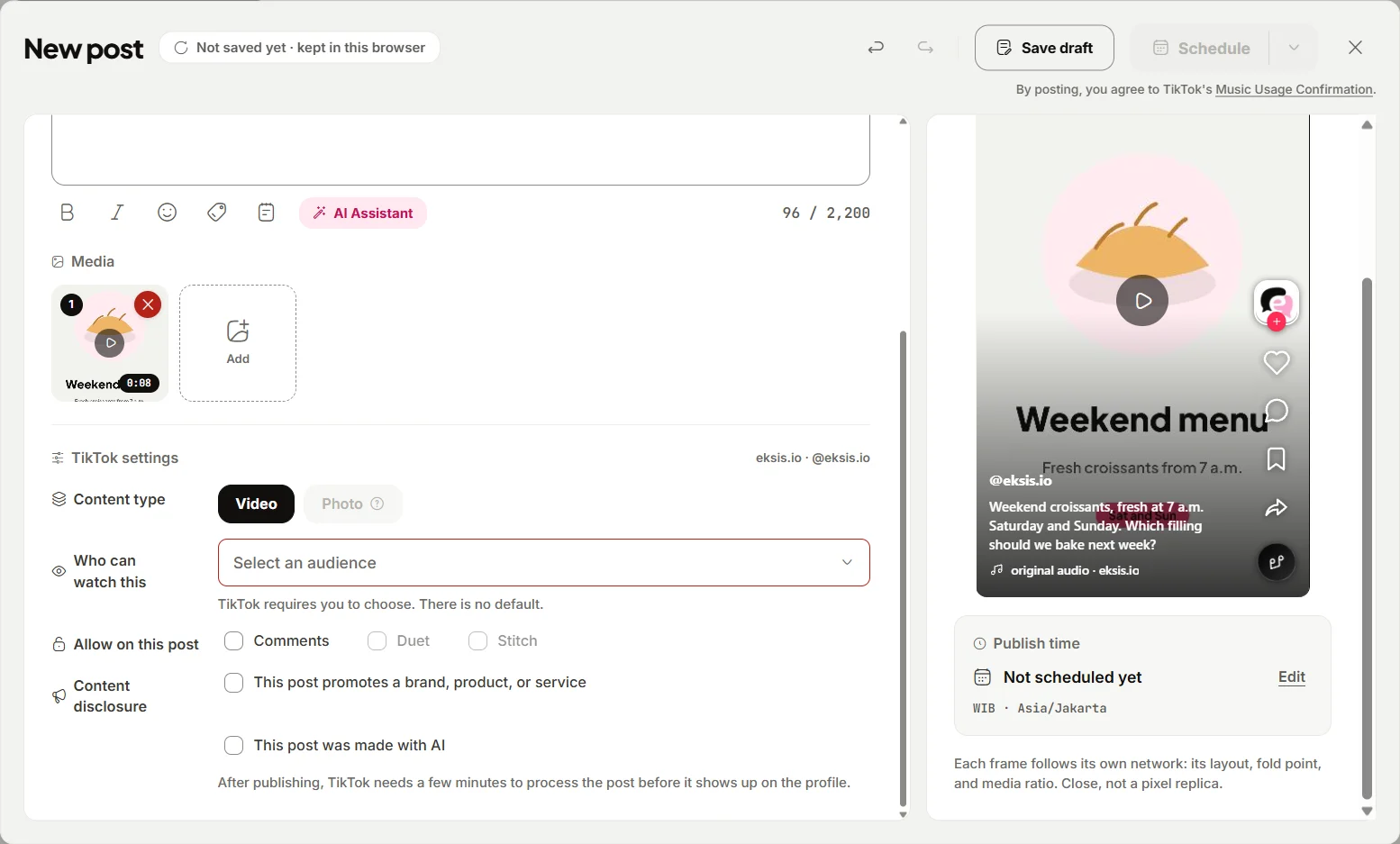
eksis passes the disclosure through to the platforms whose APIs accept it. In Create post, each channel's tab has its own settings:
- YouTube: open More options at the end of the YouTube settings and set Altered content to Yes. The hint under it uses YouTube's realistic-content test: a real person shown saying or doing something they did not, altered footage of a real event or place, or a realistic scene that never happened. eksis sends it as YouTube's altered or synthetic media flag. YouTube's help page now also lists AI music that is the main focus of a video, so answer Yes for that too.
- TikTok: tick This post was made with AI on the TikTok tab. eksis sends it as TikTok's AI-generated content flag.
- X: turn on Made with AI. eksis tells X the post contains AI-generated media, and X shows a label on the post.
For Instagram and Pinterest, eksis has no AI label option yet. If a post needs Meta's disclosure, such as a photorealistic AI video, publish that one from the Instagram app with the label. For Pinterest, create the Pin in Pinterest and use Mark as AI-Modified. Both platforms can still add labels on their own from metadata and detection, including on posts you schedule.
eksis itself does not detect AI content or decide whether a post needs a label; that decision stays with you. If you draft captions with the Assistant on Home, the text is yours to edit before anything goes out, and the platforms' labeling rules above are about realistic images, video, and audio. Scheduling to YouTube, TikTok, Instagram, and Pinterest works on every plan, including Free with one connected account, while posting to X uses X credits; see plans, the YouTube integration, and the TikTok integration. For writing with AI without losing your voice, read how to use AI for social media posts.
Sources
- YouTube Help: Disclosing use of GenAI content (no date shown)
- TikTok Community Guidelines: Integrity and Authenticity (released August 25, 2026, effective September 24, 2026)
- TikTok Newsroom: New labels for disclosing AI-generated content (fall 2023)
- TikTok Newsroom: Partnering with our industry to advance AI transparency and literacy (May 2024)
- Meta: How Meta Is Preparing for the 2026 US Midterm Elections (February 19, 2026, updated June 1, 2026)
- Meta: Our Approach to Labeling AI-Generated Content and Manipulated Media (April 5, 2024, updated September 12, 2024)
- Instagram for Creators: Bringing More Transparency to AI-Generated Profiles on Instagram (2026, exact date not shown)
- Instagram Help Center: Recommendations on Instagram (no date shown)
- Pinterest Help: Gen AI labels (updated October 20, 2026)
- Pinterest Help: Create a Pin from an image or video (no date shown)
- Pinterest Newsroom: Introducing Gen AI Labels (April 30, 2025)
All were read on October 24, 2026. This guide explains the platforms' published rules and is not legal advice; some countries also have their own AI disclosure laws.
Frequently Asked Questions
Do I have to label AI-generated content on social media?
On YouTube, TikTok, and Instagram, yes when it is realistic: a real person shown doing or saying something they did not, a realistic scene that did not happen, or, on Instagram, photorealistic video or realistic-sounding audio that was created or altered. Minor edits and clearly non-realistic content are outside those rules.
Does an AI label reduce reach?
YouTube says disclosing alone will not limit a video's audience or its eligibility to earn money. Instagram says creators who add the AI-generated profile label will not see a change in reach, while unlabeled AI-generated profiles may be limited. TikTok and Pinterest do not say labels affect distribution on the pages we read.
Do I need to label a caption written with AI?
None of the platform pages we read require labels for text. Their rules cover realistic images, video, and audio. Instagram says using AI tools as part of your creative process does not by itself require its AI-generated profile label.
What happens if I don't label AI content?
YouTube may add a label itself, remove content, or suspend you from the Partner Program for repeated failures. TikTok says unlabeled content may be removed, restricted, or labeled. Meta says it may apply penalties. All three also add labels automatically when they detect AI signals such as C2PA metadata.
Can I add AI labels when scheduling posts?
In eksis, yes for YouTube (Altered content), TikTok (This post was made with AI), and X (Made with AI). eksis has no AI label option for Instagram or Pinterest yet, so post those from the platform's own app when a label is needed.