Link in the post or in the first comment on LinkedIn? What the 2026 data shows
Four studies published in 2026 put the reach cost of a LinkedIn link between 16% and 36%, and they split on whether the first comment helps. The numbers side by side, where they disagree, and a six-week test for your own profile.
11 min read



On this page
On LinkedIn, a link in the post body costs reach in every large dataset published in 2026, somewhere between 16% and 36% depending on the study. Moving the link to your own first comment wins some of that reach back in one dataset, but another finds the comment link gets hidden and clicked far less. So the honest answer is: it depends on whether you want people to see the post or to click the link.
This is the data-heavy companion to our guide on how LinkedIn ranks posts. It puts four studies published in 2026 side by side, as they read on October 24, 2026, shows where they disagree, and ends with a way to test it on your own profile. For what to put in a first comment on any platform, see what to put in the first comment.
The short answer
- Every study published in 2026 that we found shows link posts reaching fewer people: about 16% fewer (Richard van der Blom), 26.5% (Ordinal), 28% for link preview cards (Buffer), and 36% (LinkPost).
- How the link appears matters in Buffer's data: a preview card cost 28% of impressions, a plain URL in the text about 16%.
- Link previews got about 87% more clicks in Buffer's data. Fewer people see the post, but more of them click.
- A link in your own comment: Buffer saw about 15% more impressions than similar posts with no link. Van der Blom reports that LinkedIn hides link comments from the default view in up to 80% of cases and that a link in the post converts 5.2 times better.
- Ordinal finds the reach cost mostly on Company Pages, with personal profiles showing almost none.
- If the click is the point, put the link in the post. If reach is the point, leave it out or test the comment.
What LinkedIn says
LinkedIn has not published any rule that ranks link posts lower. In 2025, Rishi Jobanputra of LinkedIn's product team said in a LinkedIn video that posts are not penalized for external links, as reported by Buffer and Breakout Insights. LinkedIn's engineering blog (March 12, 2026) does say its ranking model predicts "long dwell", whether people stay on a post, alongside likes, comments, and shares. A post built to send people away gives them less reason to stay, which is the explanation most of the studies below offer for the gap they see.
What four studies found
| Study | Published | Sample | Main finding on links |
|---|---|---|---|
| Buffer | October 5, 2026 | A year of posts from more than 58,000 accounts posting through Buffer; posts with and without links compared within the same account and month | Link preview: 28% fewer impressions, 44% fewer engagements. Plain URL in text: about 16% fewer of each. Previews: about 87% more clicks |
| LinkPost | July 12, 2026 | 358,021 posts from 30,843 profiles, 2020 to April 2026, 62% in French | Median 448 impressions with an external link against 705 without, a 36% gap |
| Richard van der Blom | July 26, 2026 | Close to 300,000 posts published March to June 2026 | One external link: 16% less reach, down from 18.8% in his earlier measurement. Two or three links: about 7% below baseline. More than that: 24% below |
| Ordinal | August 8, 2026 | Posts from early 2023 to early 2026; total sample not shown on the page we read | Median 26.5% less reach for link posts, growing from 5% in 2023 to 42% in 2025, concentrated on Company Pages |
All four are observational. None of them can prove the link causes the drop, and two say so plainly: LinkPost points out that link posts are often promotional and may simply be written with weaker hooks, and Ordinal calls the effect "an observed correlation across large samples."
Buffer's design is the strictest of the four, because it compares each account with itself in the same month. That removes the most obvious problem, which is that accounts sharing lots of links may differ from accounts that do not.
Where the studies disagree
On the first comment
This is the biggest split, and it is about two different outcomes.
- Buffer, on reach: posts where the account added the link in its own comment got about 15% more impressions than similar posts with no link at all. Buffer adds a caveat: the figure comes only from accounts whose comments it can see, so it calls it "more a promising sign than proof."
- Van der Blom, on visibility and clicks: he reports that LinkedIn now hides comments containing links from everyone except the author in up to 80% of cases under the default "relevance" sort, and that readers can need up to four extra clicks to find them. He also reports that a link in the post converts 5.2 times better than the same link in the comments.
- LinkPost: recommends the first comment as the default, while noting its data measures correlation, not cause.
- Ordinal: says the first comment still helps on Company Pages, but "costs you a large share of clicks."
So the same move can raise impressions and lower clicks at once. None of the four measured both on the same posts.
One more claim circulates without data behind it: an August 26, 2026 opinion piece on Agility PR says links cost "approximately 60 per cent" of reach and that the first-comment workaround "has also been penalised as of early 2026." It does not publish a sample or method, so we would not plan around it.
On how big the penalty is
The range of 16% to 36% is wide, and the studies explain part of it themselves. Ordinal and LinkPost report medians, which are less swayed by a few viral posts than averages. LinkPost's corpus reaches back to 2020 and is mostly French-language. Van der Blom's covers four months of 2026. Ordinal reports the gap growing from 2023 to 2025, so a study's time window moves its number.
On profiles and Company Pages
Ordinal's segmentation found Company Pages taking most of the reach cost and personal profiles showing almost none, and it argues that people posting from a profile are giving up clicks to avoid a penalty that barely applies to them. Ordinal adds that the gap widens for profiles with larger followings. The other three studies do not split their results by account type, so this is one source.
On the preview card versus a plain URL
Ordinal writes that no public study has separated the effect of the URL from the effect of the preview card. Buffer's October 2026 data does: 28% fewer impressions with a preview card against about 16% with a plain URL in the text, where engagement fell by the same share as impressions so the engagement rate held steady. That is one dataset, but it is a large one with a within-account design.
How to decide for one post
Pick the outcome first, because no placement wins on both.
| Your goal for this post | What the data points to |
|---|---|
| Clicks: a sign-up, a sale, a booking | Put the link in the post. Buffer saw 87% more clicks with preview cards, and van der Blom reports 5.2 times better conversion than a comment link |
| Reach: being seen by more of the right people | Leave the link out and make the post complete on its own, or test the link in your comment |
| Both, over a week | Post the full idea without a link first, then a shorter post with the link a day or two later |
Two habits help either way. Make the post worth reading without the click, so the people who do see it stay on it. And if you include a link, give the reason to click in the line just before it, so the click is a choice rather than a guess.
Test it on your own profile
Studies of hundreds of thousands of posts describe averages. Your profile is one account. A simple test over six weeks:
- Pick one kind of post you share often, such as a new blog article or a product update.
- Publish it in three ways, two of each, spread across the six weeks: link with a preview card, link as plain text in a post with a photo, and no link in the post with the link in your own comment.
- Keep the topic, length, and posting time similar, so the link placement is the main difference.
- After seven days, write down impressions and engagements for each post from LinkedIn's analytics. For clicks, use a tagged link (for example with UTM parameters) and count visits in your website analytics. Compare medians, not totals, because one post that takes off will skew an average.
- Keep the placement that best serves your goal, and test again next quarter. Van der Blom's single-link figure moved from 18.8% to 16% between his two measurements, so last quarter's answer may not hold.
On a personal profile, click the Me icon, choose View Profile, and click Show all in the Analytics section. Content analytics ranks your posts by impressions or engagements over the dates you pick.
Run the test in eksis
eksis publishes to your personal LinkedIn profile, not Company Pages, so this applies to the account type where Ordinal found the smallest link cost. The three versions map onto eksis like this:
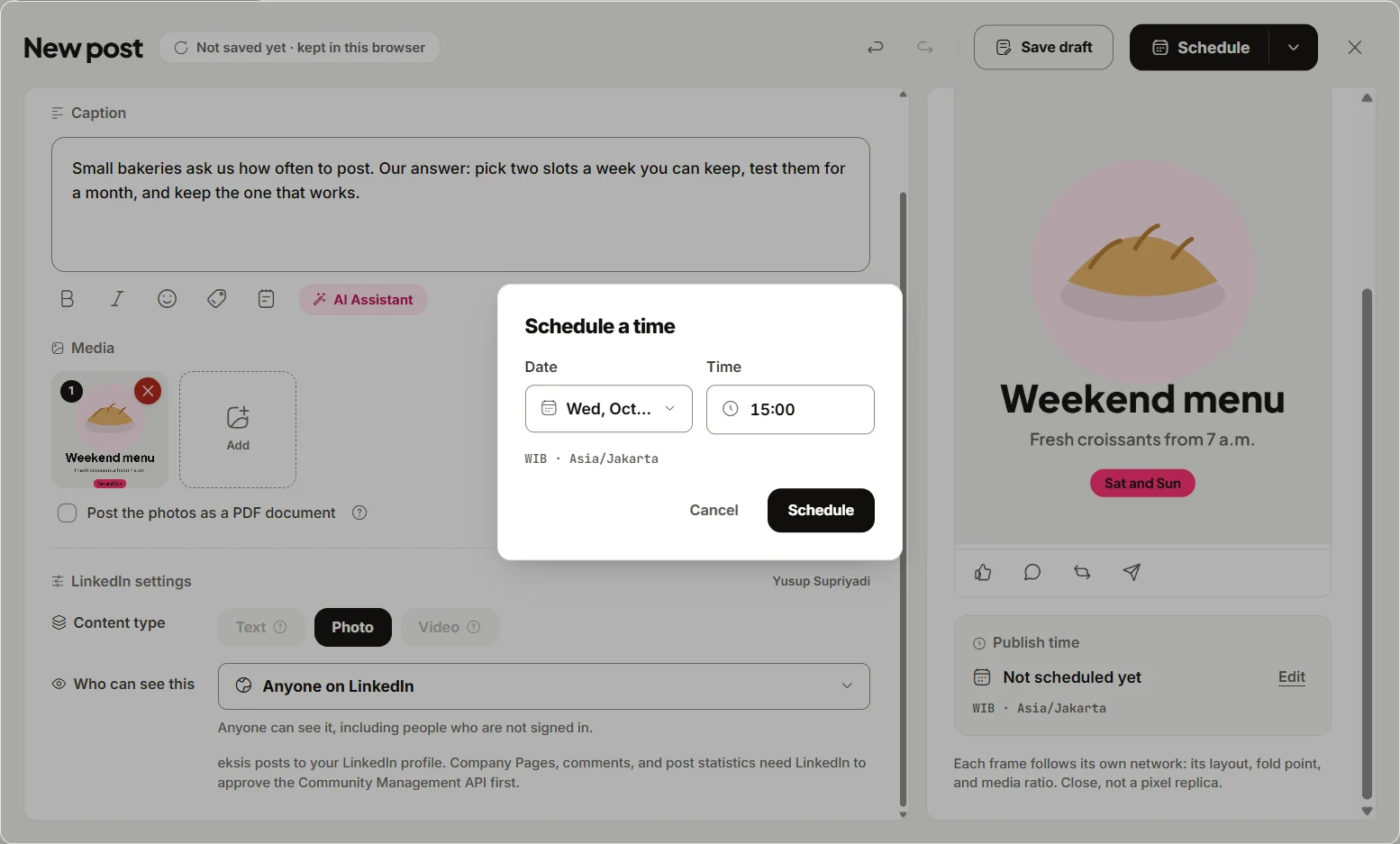
| Version | How to make it in eksis |
|---|---|
| Link with a preview card | Click Create post, pick your LinkedIn profile, write the caption with the URL, and add no photo or video. eksis publishes it as a link card, the way LinkedIn shows a shared article |
| Plain URL in the text | Same, but attach a photo. LinkedIn's posting API does not combine a photo with a link card, so the URL stays as text |
| Link in your own comment | Write the post without the URL and schedule it. eksis cannot post a first comment on LinkedIn, because that needs LinkedIn's Community Management API, which eksis has not been approved for. Add the comment yourself in LinkedIn right after the post goes live |
eksis does not yet have a switch to keep a URL as text without a photo; adding a photo is the way to drop the card for now.
eksis cannot read LinkedIn statistics either, for the same API reason, so the numbers come from LinkedIn's analytics. What eksis adds is the schedule: plan all six test posts in one sitting, set them at matching times in your workspace time zone, and use Posts in List view, filtered to your LinkedIn profile and Published, to see exactly when each went out. If you want the link-free version to stand on its own, the Assistant on Home can help draft the full idea from your article's notes, which you then edit.
The Free plan connects one account and allows 15 scheduled posts a month, enough for this test. See the LinkedIn integration and plans.
Sources
- Buffer: How to Increase Your LinkedIn Followers (October 5, 2026)
- LinkPost: Do external links kill your LinkedIn reach? (July 12, 2026)
- Richard van der Blom: The Link Penalty Just Changed. Most People Missed It. (July 26, 2026)
- Ordinal: LinkedIn Link Penalty Study (August 8, 2026)
- Agility PR Solutions: The LinkedIn link tax (August 26, 2026)
- Breakout Insights: Does LinkedIn penalize external links? (July 4, 2026)
- LinkedIn Engineering: Engineering the next generation of LinkedIn's Feed (March 12, 2026)
All were read on October 24, 2026.
Frequently Asked Questions
Should I put the link in the first comment on LinkedIn?
If reach matters more than clicks, it can help: Buffer saw about 15% more impressions for posts with the link in the account's own comment than similar posts with no link. If clicks matter more, put the link in the post. Van der Blom reports that link comments are often hidden from the default view and that a link in the post converts 5.2 times better.
How much reach does a link cost on LinkedIn?
Between about 16% and 36% in four studies published in 2026: 16% (van der Blom, about 300,000 posts), 26.5% (Ordinal), 28% for posts with a link preview card (Buffer, 58,000 accounts), and 36% (LinkPost, 358,021 posts). All four are correlations, not proof that the link itself causes the drop.
Is a link preview worse than a plain URL on LinkedIn?
In Buffer's data, yes for reach: link preview posts got 28% fewer impressions, against about 16% for a plain URL in the text. But preview posts also got about 87% more clicks, so the card can be the better choice when the click is what you want.
Does the link penalty apply to personal profiles?
Ordinal found the reach cost concentrated on Company Pages, with personal profiles showing almost none, though it says the gap grows as a profile's following grows. The other studies did not split by account type, so test it on your own profile.
Can eksis post the link as a first comment on LinkedIn?
No. Posting a comment on LinkedIn needs the Community Management API, which LinkedIn approves app by app, and eksis has not been approved yet. You can schedule the post in eksis and add the comment yourself in LinkedIn once it is live.