A five-question checklist before your business jumps on a trend
Trend posts can reach new people or land badly. Five questions on timing, music and clip rights, speed, originality, and audience fit help a small business decide in ten minutes, and sitting out is a normal answer.
10 min read



On this page
A sound is everywhere this week, or a show everyone is talking about just dropped a scene that fits your product perfectly. Should your business join in? Sometimes yes. Trend posts can reach people who have never heard of you. They can also date fast, borrow music you are not allowed to use, or land badly on a day when the conversation is not funny.
Five questions sort the good ideas from the risky ones in about ten minutes: is it safe to joke about, do you have the rights, can you post it in time, does it say something only you could say, and does it fit the people who follow you. Any "no" means you sit this one out, and sitting out is a normal result.
The short answer
- Read the room first. If the moment involves someone's real misfortune, a tragedy, or a group being mocked, skip it.
- Check the rights to every sound, clip, and image. On TikTok, businesses are told to use the Commercial Music Library for commercial content. On Instagram, some business accounts cannot use the licensed music library at all.
- Give yourself a deadline. If you cannot post at your normal quality while people still recognize the reference, let it go.
- Run an originality check: if another brand could swap in its logo and post the same thing, it is not your post yet.
- Make sure the joke fits why people follow you, so it brings in the right new viewers.
- Keep a short log of the trends you join and skip. After a few months it tells you which kinds of moments work for your account.
Where this checklist comes from
Large brands that react quickly usually have a process behind it. In an interview in Link in Bio, Rachel Karten's newsletter, IKEA global social media specialist Elissa Wardrop described a small Responsive team that meets two to three times a week, keeps a group chat going in between, and follows a cultural calendar of upcoming moments in pop culture, sport, film, music, and fashion. Every reactive post goes through a checklist: the mood of the conversation, safety and copyright issues, fit with brand values, whether it can be made quickly without losing quality, and whether IKEA has a unique angle.
A one-person business does not have a team or a standing meeting. It does have the same risks, so the questions below adapt that idea for someone deciding alone, on a phone, between other jobs.
Question 1: Is it safe to joke about right now?
Look at what the trend is actually about before you look at how popular it is. Open the original post and read the top comments. Then ask:
- Is someone's real loss, illness, or embarrassment at the center of it?
- Does the joke depend on a stereotype or on mocking a group?
- Is there a news event nearby that makes the timing look careless?
- Would you be comfortable if a child, a long-time customer, or the person being referenced saw your version?
Wardrop told Link in Bio that knowing when to stay quiet is as important as knowing when to join in, and that IKEA does not feel it needs to be part of every conversation. For a small business, one tone-deaf post can be the only thing a stranger ever sees from you, so the bar should be at least as high.
Also check your own schedule. If you have promotions queued for the same days as a sensitive news story, move them. A cheerful sale post sitting next to bad news reads as not paying attention.
Question 2: Do you have the rights to the sound, clip, or image?
This is the question small businesses skip most, and the one with clear rules on each platform.
Music and sounds
TikTok's business help center says businesses cannot use the general music library for commercial use. It points them to the Commercial Music Library, which it describes as a pre-cleared library of 1 million songs that businesses can use for organic posts, including duets and stitches, as well as ads and branded content. For original sounds from other users or other licensed sounds, TikTok tells businesses to consult their legal team.
Instagram's help center says its licensed music library is intended for personal, non-commercial use, and that certain business accounts and certain types of posts do not have access to it. Accounts without access may be able to use Meta's Sound Collection, which Instagram describes as over 14,000 royalty-free songs and sounds that can be used commercially.
So the trending song that every creator is using may not be available to your account, and even when the app lets you add it, that does not settle whether your use is commercial. When in doubt, use a commercial library track or record your own audio. Instagram lists reels with music from its library or original audio made with its Reels audio tool among the kinds of reels it recommends, so original audio does not put you at a disadvantage there.
Clips, images, and characters
Recreating a famous scene with your own products is different from uploading the scene itself. Instagram's Terms of Use say that when you post, you represent that you own or have obtained the rights to it, and they list copyright and trademark infringement among the things you cannot do. They also note that exceptions and limitations to copyright under applicable law can apply. If your idea needs someone else's footage, logo, or character to work, either get permission or find a version that does not.
Question 3: Can you post it in time, at your normal quality?
Trends move on. A reference that everyone recognizes on Tuesday can feel late by the following week. Before you start, set a deadline and a quality floor:
- Decide when the post has to be live for the joke to still land. If you cannot make that, drop it.
- Decide what "good enough" means: the photo is sharp, the text is spelled right, the product is shown properly. Do not lower that bar to be first.
Speed does not have to mean big production. Wardrop told Link in Bio that IKEA's Taylor Swift engagement post, which became IKEA UK's most-shared Instagram post, was photographed against two pieces of paper on a stool by a window. For the Punch the monkey post, she described taking 38 attempts over a 20-minute shoot, editing on the spot, and sharing the finished image with IKEA's country teams nine minutes later. Simple and fast is fine. Sloppy is not.
A practical rule for one-person accounts: give a trend idea 30 minutes. If it is not working by then, it probably will not work at all.
Question 4: Does it say something only you could say?
Wardrop calls this the originality test: if another brand could take your post, put its logo on it, and it would still work, it probably is not unique or clever enough. Her advice was to find the angle only your brand can bring, and to skip the trend if you cannot find one.
To apply it, write your idea in one sentence and replace your business name with a competitor's. If the sentence still makes sense, keep working. Angles that usually pass:
- Your actual product, used in a way that matches the reference.
- Something only your customers would recognize: a regular's order, a local landmark, a running joke from your comments.
- Your process, staff, or place, filmed the way the trend frames things.
The angle is what turns a trend post from a copy into something people send to a friend with "this is so them".
Question 5: Does it fit what people follow you for?
A trend can bring in a large audience that has no interest in what you sell. Before posting, ask whether the people who enjoy this post are people you want to see your next ten posts. A bike shop that joins a cooking trend may get views, then an audience that scrolls past every bike post afterwards.
If the trend only works by leaving your subject behind, it fails this question even if it passes the other four.
What to do with the answers
Go through the questions in order and stop at the first "no".
| Question | A "no" looks like | What to do |
|---|---|---|
| 1. Safe to joke about | The moment involves real harm or mocks a group | Sit it out, and check your scheduled posts for that week |
| 2. Rights | The sound is from the general library, or the idea needs someone else's footage | Swap in a commercial track or your own audio, or drop it |
| 3. In time, at your quality | You cannot post before the reference fades | Drop it or save the format for a future moment |
| 4. Only you could say it | A competitor could post the same thing | Look for a product, customer, or place angle, or drop it |
| 5. Fits your audience | The people it attracts are not your customers | Drop it |
Then add a short entry to a trend log: what the trend was, what you decided, and if you posted, how it did against your usual posts. After a few months the log shows which kinds of moments suit you, and the decision gets faster.
Run the checklist in eksis
eksis does not judge trends for you, but it keeps the checklist, the log, and the schedule in one place.
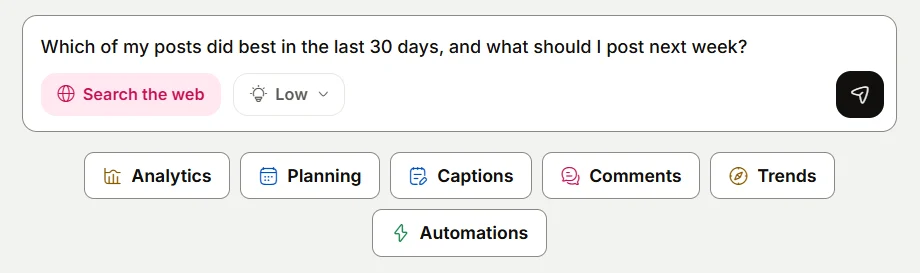
- Open Create Idea in the sidebar to reach the Idea board. Add a column called Trends. When you spot one, add a New idea, paste the five answers into the notes, and attach a screenshot or reference under Media. Tag ideas with the result (for example "posted" or "skipped") so the board doubles as your trend log.
- When an idea passes, choose Create post on it. In the composer, write a separate caption on each channel's tab if the reference reads differently on each platform.
- For a fast trend, choose Publish now from the Schedule menu. For a cultural moment you know is coming, choose Schedule a time and set it ahead.
- When sensitive news breaks, open Posts and check the Week view. Drag a scheduled post to a later time, or open it in Post details to edit or delete it.
- On paid plans, News in the sidebar is a curated feed of timely topics, and the Assistant on Home can look through it with the "Find timely topics" suggestion. Treat what it finds as a starting point and still run the five questions yourself.
The composer checks posts against each network's rules, but it does not check music licensing or copyright, and eksis publishes your file as it is. The rights question stays with you. See plans and what eksis publishes on TikTok and Instagram.
Related reading
- How to post one vertical video to TikTok, Instagram Reels, and YouTube Shorts, including the music rules on each platform
- How to plan a week of social media posts in one sitting
- How to use AI for social media posts without sounding like a bot
Sources
- Link in Bio: IKEA has a team just for reactive posts, interview with Elissa Wardrop
- TikTok Business Help Center: About the Commercial Music Library
- Instagram Help Center: Access to the licensed music library on Instagram
- Instagram Help Center: What kind of reels you may see on Instagram
- Instagram Help Center: Terms of Use
- Instagram: Instagram Ranking Explained, by Adam Mosseri
All were read on October 24, 2026.
Frequently Asked Questions
Can a business account use trending sounds on TikTok?
TikTok's business help center says businesses cannot use the general music library for commercial use and should use the Commercial Music Library, a pre-cleared library of 1 million songs, for organic posts, ads, and branded content. For other users' original sounds, TikTok tells businesses to check with their legal team.
Why can't my Instagram business account add popular music?
Instagram says its licensed music library is for personal, non-commercial use, so certain business accounts and certain post types do not have access. Those accounts may be able to use Meta's Sound Collection, over 14,000 royalty-free songs and sounds that can be used commercially.
How fast do I need to post a trend?
There is no fixed window. Set your own deadline before you start: the latest point at which people will still recognize the reference. If you cannot post by then at your normal quality, skip it.
What is the originality test for trend posts?
It comes from IKEA's Elissa Wardrop in an interview with Link in Bio: if another brand could put its logo on your post and it would still work, the idea is not specific enough. Look for an angle that depends on your own product, customers, or place.
Is it bad to skip trends?
No. A skipped trend costs you one post. A post that is insensitive, uses music you are not licensed for, or attracts the wrong audience can cost more than that. Skipping is one of the expected outcomes of the checklist.